Introduction
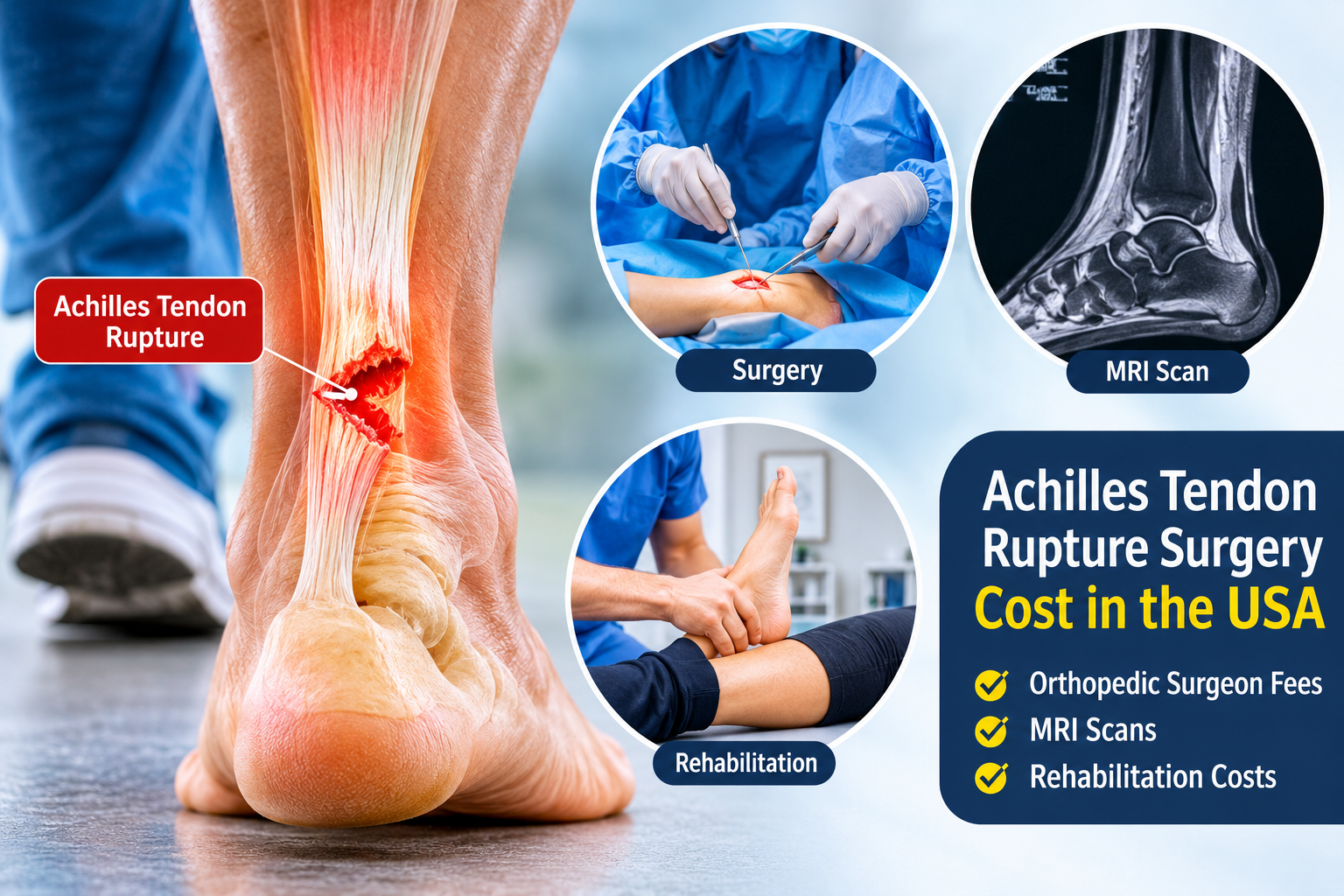
An Achilles tendon rupture is a serious injury involving the tendon that connects the calf muscles to the heel bone. This tendon plays an essential role in walking, running, jumping, and pushing the foot downward. A rupture can happen during sports, sudden acceleration, jumping, or an unexpected change in direction. Some people experience a sudden popping sensation followed by pain, swelling, and difficulty standing on their toes.
Treatment depends on the patient’s age, activity level, injury severity, and overall health. Some ruptures can be managed without surgery using a specialized walking boot and a carefully supervised rehabilitation program. Other patients may benefit from surgical repair, in which the torn tendon ends are reconnected. Treatment may involve orthopedic consultations, MRI scans, anesthesia, surgical facility charges, medication, and several months of physical therapy.
In the United States, the overall cost depends on the surgical technique, hospital or surgery center, surgeon’s professional fee, imaging requirements, and recovery plan. Surgery and extended rehabilitation can become expensive, particularly when complications or additional procedures occur. Understanding the main expenses helps patients compare providers and prepare financially.
Understanding Achilles Tendon Rupture
The Achilles tendon is the strongest and largest tendon in the human body. It transfers force from the calf muscles to the heel, allowing the foot to push against the ground. A complete rupture means the tendon has torn through, while a partial rupture involves damage to only some of its fibers.
Common symptoms include:
- A sudden popping or snapping sensation near the back of the ankle.
- Pain and swelling above the heel.
- Difficulty walking or pushing off with the injured foot.
- Weakness when attempting to stand on the toes.
- A visible or palpable gap in the tendon in some cases.
- Bruising around the ankle or lower leg.
Doctors may perform a physical examination, including the Thompson test, to assess tendon function. Ultrasound or MRI may be recommended when the diagnosis or extent of injury is uncertain. Anyone who suspects an Achilles tendon rupture should seek prompt medical evaluation and avoid attempting to exercise through the injury.
Cost Breakdown by Country
Achilles tendon treatment prices vary between countries because of differences in hospital facilities, surgeon experience, medical technology, insurance arrangements, and rehabilitation services. The following figures are broad private-treatment planning estimates for diagnosis, surgery, and related recovery care. They are not guaranteed package quotations, and the services included can differ between providers.
| Country | Estimated Treatment Price (USD) | Typical Healthcare Setting |
|---|---|---|
| United States | $8,000–$25,000 | Private hospitals and outpatient surgery centers |
| United Kingdom | $5,000–$13,000 | Private orthopedic hospitals |
| India | $1,500–$5,000 | Private multispecialty hospitals |
| Pakistan | $1,000–$4,000 | Private orthopedic hospitals |
| Turkey | $2,500–$7,000 | Private surgical centers |
| Thailand | $3,000–$8,000 | Private international hospitals |
| Australia | $5,000–$14,000 | Private hospitals and day surgery centers |
These international figures are approximate and do not represent identical medical packages. Some facilities include surgeon fees, anesthesia, and follow-up appointments, while others charge separately for each service. Public healthcare systems may cover eligible patients under specific conditions, whereas private patients generally pay according to the provider’s charges and their insurance benefits.
USA Achilles Tendon Surgery Expense Breakdown
In the United States, the total bill can include the initial consultation, diagnostic imaging, surgical repair, anesthesia, medical equipment, and rehabilitation. The following table gives illustrative private-pay estimates for common services.
| Medical Service | Estimated Price (USD) |
|---|---|
| Initial orthopedic surgeon consultation | $150–$500 |
| Ankle MRI scan | $400–$2,000 |
| Ultrasound or additional diagnostic examination | $150–$700 |
| Surgeon’s professional repair fee | $1,000–$4,000 |
| Hospital or outpatient surgery center facility | $3,000–$9,000 |
| Anesthesia services | $500–$2,000 |
| Walking boot, crutches, and medication | $200–$800 |
| Physical therapy and rehabilitation | $1,000–$4,000 |
These are planning estimates, not a fixed national fee schedule. A published hospital price-transparency analysis for Achilles tendon repair reported a median listed self-pay facility price of approximately $4,877 across 1,644 hospitals, with substantial variation. That figure generally represents the facility component, not every professional and recovery service a patient may need.
Another national cash-price estimate places a typical combined treatment pathway at approximately $9,940 in a surgery center and $13,929 in an outpatient hospital. These figures illustrate how the setting and included services can affect the final bill. Patients should request a written estimate to determine what is included.
MRI Scans and Diagnostic Examination Fees
An MRI scan provides detailed images of the Achilles tendon and surrounding soft tissues. It can help identify the location of a tear, the distance between torn tendon ends, and associated injuries. MRI is not always necessary because many complete ruptures can be diagnosed through a clinical examination.
Ultrasound is another useful diagnostic option. It can show tendon continuity and movement in real time and may be less costly than MRI. The doctor decides which test is appropriate based on the examination and clinical findings.
Diagnostic expenses may include:
- Orthopedic examination: Assessment of pain, swelling, tendon function, and walking ability.
- Thompson test: A physical examination used to help identify a complete rupture.
- Ultrasound: Imaging that can show tendon damage and the location of a tear.
- MRI: Detailed imaging when additional information is needed for diagnosis or treatment planning.
- Preoperative tests: Blood tests or medical clearance when required before surgery.
Patients should ask whether the imaging quotation includes the radiologist’s interpretation. Hospital-based imaging and independent diagnostic centers may have different prices.
Orthopedic Surgeon Fees and Surgical Techniques
An orthopedic foot and ankle specialist or another qualified orthopedic surgeon may perform Achilles tendon repair. Professional fees depend on the surgeon’s experience, location, procedure complexity, and whether additional reconstruction is required.
Two common surgical approaches are open repair and minimally invasive or percutaneous repair. During open repair, the surgeon makes an incision to access and reconnect the torn tendon. Minimally invasive techniques use smaller incisions and specialized instruments to bring the tendon ends together.
The choice depends on injury characteristics, tissue quality, patient health, and the surgeon’s assessment. Neither technique is automatically suitable for every patient. Patients should discuss possible benefits, wound risks, nerve injury, rerupture, and recovery expectations before deciding.
Hospital Charges, Anesthesia and Surgical Equipment
Achilles tendon repair is commonly performed as an outpatient procedure, meaning many patients return home on the same day. The facility bill may include operating-room use, nursing care, surgical supplies, and recovery-room services.
Anesthesia may be general or regional, depending on the patient’s needs and the surgical plan. The anesthesia professional may bill separately from the surgeon and facility.
Other expenses can include:
- Splints, casts, or postoperative protective boots.
- Crutches or other mobility aids.
- Sutures and surgical supplies.
- Prescription medication for short-term pain control.
- Postoperative wound checks and dressing supplies.
Some facilities combine these services in a bundled quotation. Others bill them separately, so patients should check the estimate carefully.
Physical Therapy and Rehabilitation Expenses
Rehabilitation is essential after Achilles tendon rupture treatment. The tendon needs time to heal, and patients must gradually restore ankle movement, calf strength, balance, and walking ability. Returning to activity too quickly can increase the risk of reinjury.
After surgery, patients are usually placed in a splint, cast, or protective walking boot. The treating surgeon determines when weight-bearing and movement can begin. Rehabilitation commonly progresses through several stages:
- Protection phase: The tendon is protected while early healing takes place.
- Controlled movement: Gentle ankle movement begins when medically approved.
- Strengthening: Exercises gradually rebuild calf and ankle strength.
- Balance training: Patients work on stability and coordination.
- Functional recovery: Walking, stairs, and eventually higher-level activities are reintroduced.
The American Academy of Orthopaedic Surgeons explains that immobilization may last around six weeks, depending on the treatment plan. Complete recovery can take approximately 12 months, and some people need longer to achieve their activity goals. The number of therapy sessions, clinic fees, and recovery duration influence rehabilitation spending.
Factors Influencing Price Differences
Several factors can affect the amount a patient pays for Achilles tendon rupture surgery in the United States.
- Insurance coverage: Deductibles, copayments, coinsurance, and network rules determine the patient’s share.
- Hospital selection: An outpatient surgery center may have different facility charges from a hospital.
- Surgeon experience: Specialist fees vary according to training, location, and procedure complexity.
- Injury severity: Delayed treatment, poor tendon quality, or a large gap may require more complex repair.
- Surgical technique: Open, minimally invasive, and reconstructive procedures have different resource requirements.
- Diagnostic imaging: MRI and ultrasound charges depend on the facility and services included.
- Rehabilitation needs: The number of physical therapy sessions affects ongoing spending.
- Complications: Infection, wound problems, nerve injury, or rerupture may require additional care.
How Health Insurance Affects the Final Bill
Many US insurance plans cover medically necessary Achilles tendon repair, diagnostic imaging, and rehabilitation, but coverage depends on the policy. Some insurers require prior authorization for MRI scans, surgery, or physical therapy. Patients may also need to use in-network surgeons and facilities to receive the highest level of coverage.
Before scheduling surgery, patients should confirm:
- Whether the surgeon and surgical facility are in-network.
- Whether MRI or ultrasound requires prior authorization.
- Whether anesthesia is covered under the same network arrangement.
- How much deductible remains for the current policy year.
- How many physical therapy sessions are covered.
- Whether the walking boot, crutches, and postoperative appointments are included.
Uninsured patients can request a written self-pay estimate and ask about payment plans or financial assistance. The estimate should clarify whether it includes the surgeon, facility, anesthesia, and postoperative services.
Ways to Manage Treatment Expenses
Patients can take practical steps to manage medical spending without compromising the quality of care.
- Compare written estimates from qualified orthopedic specialists.
- Ask whether an outpatient surgery center is appropriate for the procedure.
- Check insurance coverage before scheduling imaging or surgery.
- Request separate estimates for the surgeon, anesthesia, and facility.
- Ask whether rehabilitation services are covered by insurance.
- Discuss suitable nonsurgical treatment when medically appropriate.
- Follow the rehabilitation plan to support safe recovery.
Conclusion
Achilles tendon rupture treatment in the United States can involve orthopedic consultations, MRI scans, surgical repair, anesthesia, protective equipment, and physical therapy. The overall cost depends on the injury, surgical setting, specialist fees, insurance coverage, and rehabilitation requirements. More complicated repairs and extended recovery can become expensive, while appropriate nonsurgical treatment may be suitable for selected patients.
Patients should obtain a written estimate, confirm insurance benefits, and discuss surgical and nonsurgical options with a qualified orthopedic specialist. Following the recommended protection and rehabilitation plan is important for restoring tendon function. All prices in this article are approximate educational estimates, not guaranteed quotations or personalized medical advice. Actual charges and treatment decisions should be confirmed with the treating provider and insurer.
SEO Keywords
Achilles Tendon Rupture Surgery Cost in USA, Achilles tendon repair price, orthopedic surgeon fees, Achilles tendon MRI scan cost, ankle MRI price USA, Achilles tendon surgery expenses, Achilles rehabilitation costs, physical therapy after Achilles surgery, outpatient tendon repair price, Achilles tendon surgery insurance coverage, Achilles rupture treatment prices by country.
