Introduction
A hip labral tear is an injury involving the labrum, a ring of strong cartilage that surrounds the outer edge of the hip socket. This cartilage helps deepen the socket, maintain joint stability, and create a seal that supports smooth movement between the thigh bone and pelvis. When the labrum becomes damaged, patients may experience persistent hip pain, stiffness, clicking, catching, or difficulty participating in physical activities.
Treatment depends on the location and severity of the tear, the patient’s age, activity level, joint condition, and response to conservative care. Some people improve with activity modification, medication, and physical therapy. Others may require an MRI scan, an orthopedic specialist assessment, or hip arthroscopy to repair the damaged cartilage. Arthroscopic surgery is a minimally invasive procedure that uses a small camera and specialized instruments inserted through small incisions around the hip.
In the United States, the total cost of treatment may include orthopedic consultations, X-rays, MRI or MR arthrogram imaging, diagnostic injections, anesthesia, surgical facility charges, and postoperative rehabilitation. Complex procedures, additional bone correction, or private hospital services can become expensive. Understanding the possible expenses before treatment helps patients compare providers, review insurance benefits, and prepare financially.
Understanding a Hip Labral Tear
The hip is a ball-and-socket joint. The rounded top of the thigh bone, called the femoral head, fits into the acetabulum, which is the socket in the pelvis. The labrum is a flexible cartilage structure attached around the socket. It helps keep the femoral head properly positioned and contributes to joint stability.
A tear can develop because of a sudden injury, repeated twisting movements, structural differences in the hip, or gradual cartilage degeneration. One common associated condition is femoroacetabular impingement, also known as FAI. It occurs when extra bone or an unusual shape around the hip joint causes abnormal contact during movement.
Common symptoms include:
- Pain in the groin or front of the hip.
- Clicking, catching, or locking sensations during movement.
- Discomfort after prolonged sitting or driving.
- Pain during running, squatting, twisting, or climbing stairs.
- Reduced hip movement or stiffness.
- Discomfort during sports and other demanding activities.
These symptoms do not automatically confirm a labral tear. Hip flexor problems, arthritis, bursitis, muscle injuries, and lower-back conditions can produce similar discomfort. A qualified healthcare professional should assess the symptoms before treatment is selected.
Diagnosis and Medical Evaluation
Diagnosis usually begins with a review of symptoms, medical history, previous injuries, and physical activity. The orthopedic specialist may examine hip movement, strength, walking pattern, and pain during particular movements. Special examination tests can help identify pain originating inside the hip joint.
Imaging may be recommended to investigate the cartilage and identify other structural problems.
- X-rays: These images help examine the shape of the hip bones, joint space, arthritis, and possible bone abnormalities associated with FAI.
- MRI scan: Magnetic resonance imaging provides detailed information about soft tissues, including the labrum, cartilage, tendons, and surrounding structures.
- MR arthrogram: This examination combines MRI imaging with contrast material injected into the hip joint to improve visualization of certain labral injuries.
- Diagnostic injection: A doctor may inject local anesthetic into the joint to determine whether the hip joint is responsible for the patient’s pain.
Not every patient needs every test. The orthopedic specialist selects imaging according to the examination findings and the clinical question. The Mayo Clinic describes X-rays and magnetic resonance arthrography as useful diagnostic options, while specialist consensus guidance identifies MRA as a preferred advanced imaging approach in many suspected labral tear cases.
Cost Breakdown by Country
Prices for hip labral tear evaluation and treatment vary considerably between countries. Differences in hospital facilities, surgeon qualifications, imaging technology, anesthesia, rehabilitation services, and private healthcare systems influence the amount patients may pay. The following table provides broad private-treatment planning estimates in US dollars. These figures are not official national tariffs or guaranteed package quotations.
| Country | Estimated Treatment Price (USD) | Typical Healthcare Setting |
|---|---|---|
| United States | $8,000–$30,000 | Private hospitals and outpatient surgical centers |
| United Kingdom | $8,000–$15,000 | Private orthopedic hospitals and specialist clinics |
| India | $2,000–$7,000 | Private multispecialty hospitals |
| Pakistan | $1,500–$6,000 | Private orthopedic and surgical hospitals |
| Turkey | $3,000–$8,000 | Private hospitals and orthopedic centers |
| Thailand | $4,000–$10,000 | Private hospitals and specialist centers |
| Australia | $7,000–$18,000 | Private hospitals and day surgery facilities |
These international figures are broad estimates for comparison rather than verified standardized prices for identical procedures. Some quotations include the surgeon, anesthesia, hospital stay, and rehabilitation, while others cover only the operation or facility. Public healthcare may provide treatment for eligible residents in certain countries, subject to referral pathways and waiting times. International patients and private patients generally receive separate quotations.
USA Hip Labral Tear Treatment Price Breakdown
In the United States, the final amount depends on whether a patient receives nonsurgical care or undergoes arthroscopic surgery. A straightforward procedure may involve repairing the labrum, while a more complicated operation may include treatment of femoroacetabular impingement, cartilage damage, or other joint abnormalities.
The following table shows illustrative private-pay ranges for common services. Actual charges vary by region, provider, insurance contract, and medical complexity.
| Medical Service | Estimated Price (USD) |
|---|---|
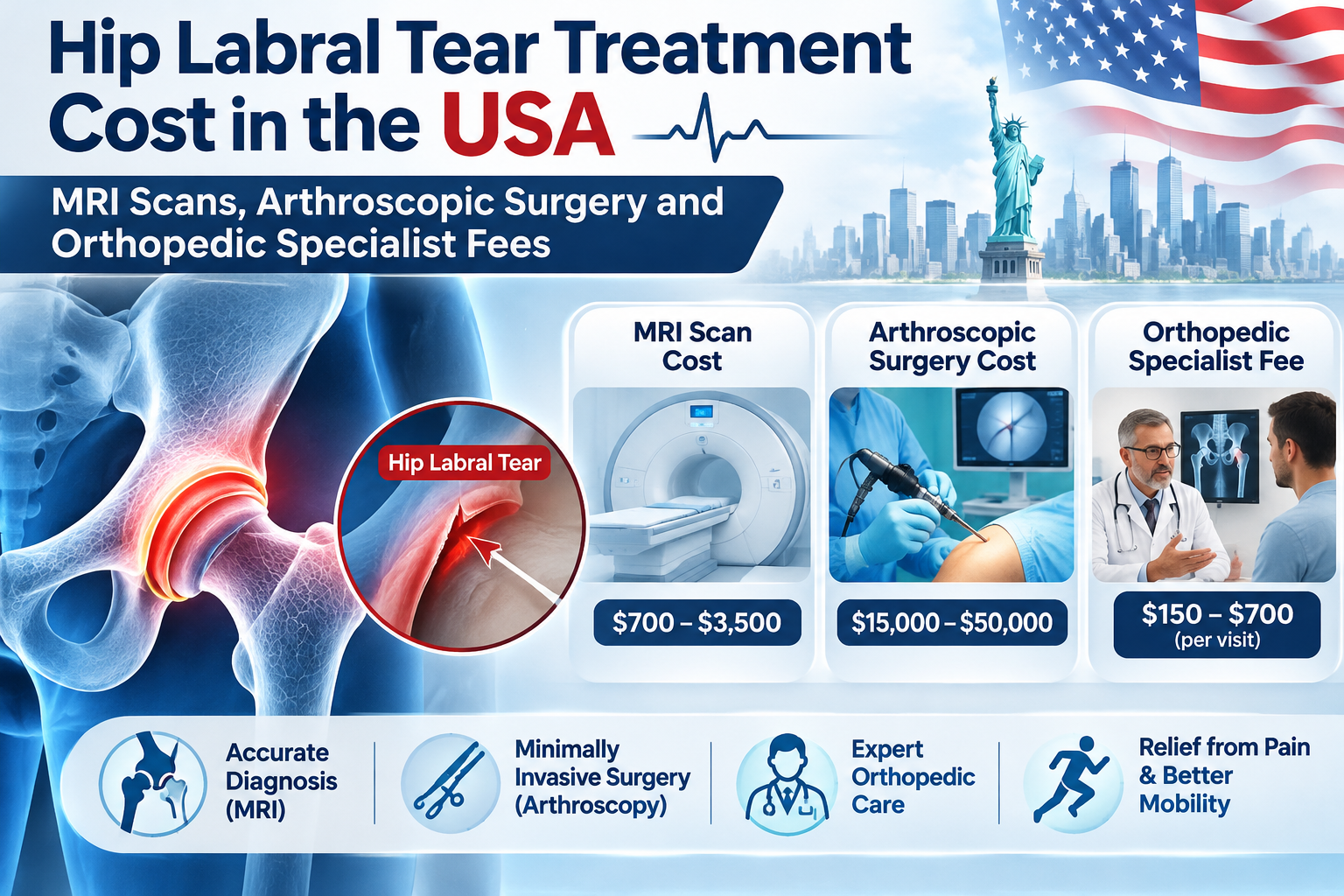
| Initial orthopedic specialist consultation | $150–$500 |
| Hip X-ray examination | $100–$500 |
| Hip MRI scan | $500–$3,000 |
| MR arthrogram with joint contrast | $1,000–$4,000 |
| Diagnostic hip injection | $300–$1,500 |
| Arthroscopic surgeon and professional fees | $2,000–$7,000 |
| Operating facility and anesthesia | $3,000–$12,000 |
| Postoperative rehabilitation and follow-up | $500–$4,000 |
These figures are planning estimates, not a promise that every patient will receive a complete treatment package within these ranges. Some services may be included in a hospital quotation, while others are billed separately. For example, an imaging center may bill independently from the orthopedic surgeon, and the anesthesia provider may issue a separate statement.
Published US hospital price-transparency data provide another useful reference. A 2026 analysis of 718 hospitals reported a median published self-pay facility price of approximately $5,500 for hip arthroscopy with labral repair under CPT 29916. The middle 50 percent of listed prices ranged from approximately $2,115 to $13,784. These figures generally represent the facility portion and may exclude surgeon and other professional fees. They should not be interpreted as the complete amount every patient will pay.
Non-Surgical Treatment Options and Their Expenses
Surgery is not the first treatment for every hip labral tear. Many patients begin with conservative management, particularly when symptoms are manageable and there is no urgent structural problem requiring an operation. The treatment plan depends on the patient’s symptoms, examination, imaging findings, and daily activity requirements.
Common nonsurgical approaches include:
- Activity modification: Temporarily reducing movements that trigger pain, such as deep squatting, repeated twisting, or high-impact exercise.
- Physical therapy: Exercises designed to strengthen the hip, gluteal, and core muscles while improving controlled movement.
- Medication: A healthcare professional may recommend appropriate pain-relieving or anti-inflammatory medication when suitable.
- Image-guided injection: An injection may help identify the source of pain or provide temporary symptom relief in selected patients.
- Home exercise program: A therapist may recommend controlled strengthening and mobility exercises that can be continued outside the clinic.
Conservative treatment may require several appointments over a period of weeks or months. The total amount depends on the number of therapy sessions, medication needs, imaging requirements, and insurance coverage. Patients should avoid starting demanding exercises without professional guidance because certain movements may aggravate hip symptoms.
Arthroscopic Hip Surgery and Surgeon Fees
Hip arthroscopy is a minimally invasive procedure used to examine and treat problems inside the hip joint. The surgeon makes small incisions and inserts a camera, allowing the joint to be viewed on a monitor. Specialized instruments are then used to repair or treat the damaged tissue.
For a labral tear, the surgeon may perform one of several procedures:
- Labral repair: The surgeon uses small surgical anchors and sutures to reattach repairable labral tissue to the hip socket.
- Labral debridement: Damaged or unstable tissue may be trimmed when it cannot be repaired appropriately.
- Labral reconstruction: In selected cases involving severely damaged tissue, a graft may be used to reconstruct part of the labrum.
- FAI correction: If abnormal bone shape is contributing to repeated contact, the surgeon may reshape the relevant area during the same procedure.
Surgeon fees depend on experience, geographic location, procedure complexity, and whether additional treatments are required. Hip arthroscopy is technically demanding, so patients should seek a specialist with appropriate experience in hip preservation and arthroscopic procedures.
Patients should ask whether the surgical quotation includes the surgeon’s fee, surgical assistants, equipment, implants or anchors, anesthesia, and facility charges. They should also confirm whether a repair, reconstruction, or additional bone procedure is planned because these operations may involve different resources.
Hospital, Anesthesia and Medical Facility Charges
Hip arthroscopy is commonly performed in a hospital or specialized outpatient surgical center. Some patients return home on the same day, while others may require a short hospital stay depending on their health, procedure complexity, and recovery needs.
Facility-related services may include:
- Operating room and surgical equipment.
- Arthroscopy camera, instruments, and disposable supplies.
- Traction equipment used to provide access to the hip joint.
- Medical staff and nursing support.
- Anesthesia and recovery-room monitoring.
- Surgical anchors, sutures, or graft materials when required.
- Postoperative wound care and discharge instructions.
General anesthesia is commonly used for hip arthroscopy, although the anesthesia plan depends on the patient’s health and the surgical team’s judgment. A hospital-based procedure may have different facility charges from an outpatient center. Patients should request an itemized estimate and check whether all professional services are included.
Recovery, Physical Therapy and Rehabilitation
Recovery after hip labral surgery is gradual. The timeline depends on the extent of the repair, whether additional bone correction was performed, the condition of the cartilage, and the patient’s overall health. A rehabilitation plan is an important part of treatment because surgery alone does not restore strength, movement, and normal activity.
During early recovery, patients may need crutches to reduce pressure on the operated hip. Weight-bearing instructions vary according to the procedure. Some patients are allowed to place limited weight on the leg, while others require more restrictive instructions for a longer period.
Rehabilitation may involve:
- Managing swelling and discomfort during the initial healing period.
- Following the surgeon’s weight-bearing and movement restrictions.
- Gradually restoring hip mobility under professional supervision.
- Strengthening the gluteal, abdominal, and surrounding hip muscles.
- Improving balance, walking pattern, and joint control.
- Returning gradually to work, exercise, and sports activities.
Physical therapy may continue for several months. Returning to running or competitive sports often takes longer than returning to basic daily activities. The American Academy of Orthopaedic Surgeons explains that rehabilitation is important after hip arthroscopy and that crutches may be needed for different periods depending on the procedure. Patients should follow their own surgeon’s instructions rather than comparing their recovery with another person’s timeline.
Factors Influencing Price Differences
Several medical, insurance, and hospital-related factors determine how much a patient may pay for hip labral tear treatment in the United States.
- Insurance coverage: Deductibles, copayments, coinsurance, network restrictions, and prior authorization requirements affect the patient’s share.
- Hospital selection: A large hospital system may have different facility charges from an independent outpatient surgical center.
- Orthopedic specialist experience: Surgeon qualifications, location, and professional fee arrangements can influence the quotation.
- Imaging requirements: A standard MRI, MR arthrogram, X-rays, or additional diagnostic imaging may be needed depending on the case.
- Type of procedure: Repair, debridement, and reconstruction involve different surgical techniques and materials.
- Associated hip conditions: FAI, cartilage damage, or other joint abnormalities may require additional treatment during surgery.
- Medical complexity: Previous surgery, other health conditions, and individual recovery needs can affect the treatment plan.
- Rehabilitation needs: The number of physical therapy sessions, specialist reviews, and recovery supplies can change the final amount.
Health Insurance and Payment Planning
Many US health insurance plans may cover medically necessary imaging, orthopedic consultations, and arthroscopic treatment when policy requirements are met. However, coverage differs between insurers and individual plans. Some policies require prior authorization, specific imaging findings, or evidence that conservative treatment has been attempted.
Before scheduling a procedure, patients should confirm:
- Whether the orthopedic specialist is in the insurance network.
- Whether the hospital or surgical center is covered.
- Whether MRI or MR arthrogram imaging requires prior approval.
- Whether the proposed surgical procedure is covered.
- How much of the annual deductible remains.
- Whether anesthesia and surgical assistant fees are billed separately.
- Whether postoperative physical therapy is included in the plan.
Uninsured patients can request a written self-pay estimate and ask about payment arrangements or financial assistance. It is useful to compare more than one qualified provider, but the lowest quotation should not be the only consideration. Patients should also evaluate the surgeon’s experience, facility standards, and the services included in the proposed treatment.
Ways to Manage Treatment Expenses
Patients can take several practical steps to make treatment planning more manageable without compromising medical care.
- Obtain an itemized written estimate before surgery.
- Compare prices from qualified orthopedic providers.
- Check insurance network status for every provider involved.
- Ask whether the MRI or MR arthrogram has already been completed and whether additional imaging is necessary.
- Discuss conservative treatment when surgery is not immediately required.
- Confirm whether implants, anesthesia, and facility services are included in the quotation.
- Ask the physical therapist for a clear rehabilitation plan and expected appointment schedule.
- Follow postoperative instructions to reduce the risk of avoidable complications.
Conclusion
Hip labral tear treatment in the United States can involve orthopedic consultations, X-rays, MRI or MR arthrogram imaging, medication, arthroscopic surgery, and postoperative rehabilitation. The overall cost depends on the surgeon, facility, insurance policy, type of labral procedure, and whether additional hip conditions need treatment. Complex reconstruction or combined procedures may become expensive, while some patients improve with physical therapy and other nonsurgical options.
Before choosing treatment, patients should discuss the diagnosis, available procedures, recovery expectations, and possible complications with a qualified orthopedic specialist. Written estimates and insurance verification can help prevent unexpected bills. The prices in this article are educational planning estimates rather than guaranteed quotations or personalized medical advice. Actual charges and treatment decisions should always be confirmed with the treating provider and insurer.
SEO Keywords
Hip Labral Tear Treatment Cost in USA, hip labral tear surgery price, hip arthroscopy cost, MRI scan price for hip labral tear, MR arthrogram price USA, orthopedic specialist fees, hip labral repair surgery, hip labral reconstruction, hip arthroscopy recovery expenses, femoroacetabular impingement surgery, hip physical therapy prices, hip labral tear treatment by country, hip surgery insurance coverage.
